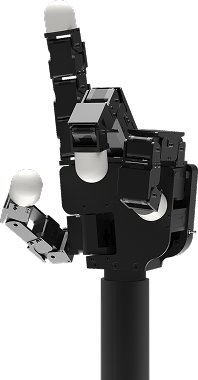
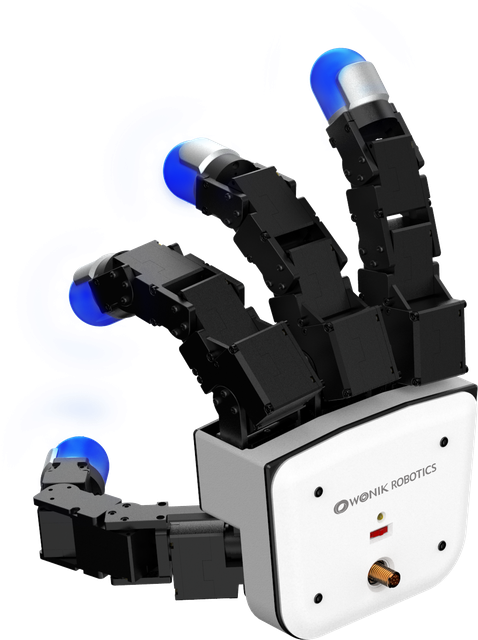
DEXTEROUS MANIPULATION

The world of dexterous hands.

Compare hardware. Discover applications. Share what works. An open reference and community for dexterous manipulation.

Compare dexterous hands

Compare finger motion, tactile sensing, weight and software for your next experiment.

Need a hand? →

Start with the task. Then compare the evidence.

221 source-linked records: commercial hands, research platforms, robot-integrated designs and adjacent grippers. A listing is not a recommendation or proof of availability.

Read the selection guide →
What should I check before choosing a hand?
Motion
Compare active and total DOF separately. More joints do not guarantee better performance on your task; check thumb opposition, coupling and joint limits.
Touch and feedback
Ask which surfaces are sensed, what the sensor measures, and whether readings are available through the SDK. Motor current is not a direct fingertip-force measurement.
Weight and integration
Check the mass boundary: hand only, wrist or complete assembly. Confirm mounting, power, communication and cable requirements with the maker.
Software and evidence
Match the exact hardware revision to its SDK, example code and simulation model. A demo or a model file is not an independent reliability test.
Price and availability
Compare one hand with one hand, and check included controllers, sensing, accessories, taxes and delivery. Missing values mean unknown, not zero.

Select two to four records using their Compare controls, then open the side-by-side comparison. Understand price scope · Plan your first integration · How we use sources

How do I turn a task into a useful shortlist?
  1. Define one observable task. Name the object, its size and surface, the required finger motion and what counts as success. Picking up a block and turning a key require different evidence. Use the task-first selection checklist.
  2. Separate requirements from unknowns. For each shortlisted model, record the exact revision, left/right hand, controllable joints, sensor outputs, SDK and mounting constraints. Mark missing information as unconfirmed; a blank field is not a failed capability. Check the integration requirements.
  3. Choose the next verification step. For simulation, inspect the model and its license before evaluating a policy. For hardware, ask the manufacturer for a demonstration of your task and the matching developer package. Explore available 3D models · Plan a simulation evaluation.

Save two to four candidates and the unresolved questions for each. A product video, DOF count or simulation model alone cannot establish that a hand meets your task.

Explore before you build.

27 licensed model versions. Rotate the geometry, inspect joints and follow the original files.

Hands with interactive 3D →Browse every model version →Versions are not unique manufacturers. Some family models do not map to an exact catalog SKU.
Coverage & gaps 221 entries · 12 added in this reviewView audit

A growing directory, with visible gaps.

Entries include product generations, configurations, research designs and adjacent grippers. The count is not a count of unique current products or proof of complete market coverage.

Active DOF established
171 / 221
Mass established
124 / 221
Numeric price / build cost
94 / 221
Product / project image
117 / 221

103 other entries use family, listing or logo references; 1 have no verified image. Price counts include dated material costs and seller offers, not just retail prices. Different mass boundaries remain visible in each entry.

Added in this pass

Still under review

Apptronik Apollo end effectors

Official materials discuss different manipulators and ongoing dexterous-hand work. Exact named hand SKU, revision and hand-only specifications still need primary confirmation; do not create a new product for every integration photo.

Starting source ↗

NEURA 4NE1 hand configurations

Official product page describes exchangeable forearms without a versioned standalone hand specification. Verify the hand maker and configuration before adding a separate model.

Starting source ↗

Tesla later production-hand revisions

The catalog’s 22-DOF entry is the 2024 engineering revision. A later robot generation must have its own primary hand specification before that label or its numbers are updated.

Starting source ↗

Figure 01 and earlier NEO hands

Historical robot names alone do not establish distinct hand designs. Earlier hand revisions need their own dated engineering evidence; current specs must not be copied backward.

Starting source ↗

Additional research and legacy families

RBO Hand 1/2, DLR generations, Krysalis, CYJ and ISyHand-related variants remain outside this pass. Verify original papers, model lineage and current status before importing numbers.

Starting source ↗

Alias and configuration consolidation

Left/right units, motor/sensor options and seller aliases are catalog entries, not automatically unique designs. Linkerbot L10 / L20 Lite equivalence remains explicitly uncertain; avoid merging without maker confirmation.

Starting source ↗

Mand.ro Mark7 robotics configurations

Robotics and prosthetic variants share a family name. Resolve exact robotics configurations, hand-only specifications and current offers before adding separate models.

Starting source ↗

DexHand v2 release status

The repository README and release/licensing language require reconciliation before treating the current design as a reproducible public build.

Starting source ↗

GaiaHand example specifications

Repository specifications are labeled as examples. A versioned hardware release and measured specifications are needed before normalization.

Starting source ↗

Gap review: 2026-10-02. Targeted October 2 review of new manufacturer listings and missing research platforms. Earlier catalog entries retain their own evidence dates; this is not a re-verification of the whole directory. Evidence standards →

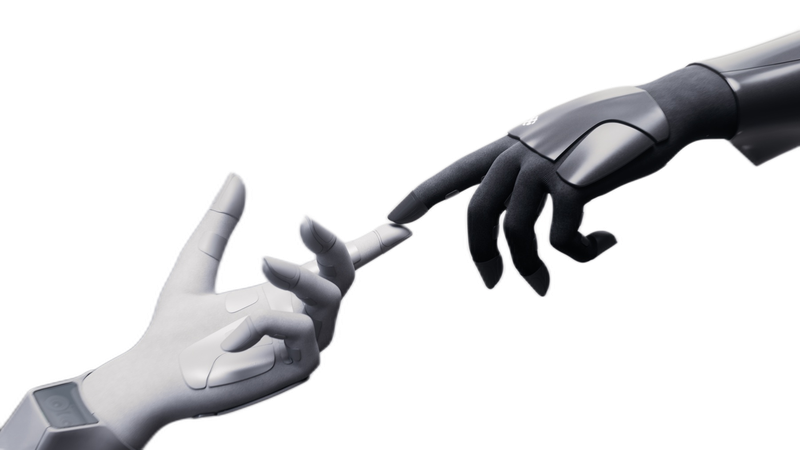
Active / total DOF: 6 / 11

Sensing: Multi-dimensional fingertip tactile module; exact output schema and firmware must be confirmed. · Weight basis: Hand only; camera excluded.

Software: Manufacturer documents Python/C SDK and Linux, Windows, ROS workflows; release/firmware compatibility not tested.

Interactive 3D · Apache-2.0 →Original source ↗

Active / total DOF: 12 / 12

Sensing: Per finger: 4 joint positions, 5 tendon forces, motor current/velocity/temperature/clutch, 3-axis accelerometer + gyro; distal optical tactile stereo video; optional Hall tactile arrays on middle/proximal phalanges · Weight basis: One complete three-finger hand, 4.1 kg; not a pair.

Software: ROS

Interactive 3D · BSD-3-Clause →Original source ↗

Active / total DOF: 20 / 20

Sensing: Manufacturer documents multi-axis fingertip force/torque sensing and per-finger SDK streams; fitted sensor package and performance require revision/BOM confirmation. · Weight basis: One Beta 2 bare hand: 0.650 kg. With pads/output cables: 0.800 kg; base: 0.070 kg separately. Seller delivery revision is unconfirmed.

Software: Python/C SDK, ROS 2; URDF/MJCF/USD

Interactive 3D · MIT →Original source ↗

Start a discussion

Published posts are public. First contributions are reviewed. Only share material you have permission to disclose.

Report a post